Bianca Fischer · 17 September 2026
Subsurface Partition Refinements That Stabilize Indexing Paths During Platform-Wide Reconfigurations
Platform operators have refined subsurface partition methods to maintain consistent indexing paths when entire systems undergo broad reconfigurations, and these adjustments address how data segments interact beneath the primary storage layers. Researchers at institutions across North America and Europe have documented how such refinements reduce path drift during node additions, removals, or topology shifts that occur in large-scale environments.
Core Mechanisms Behind the Refinements
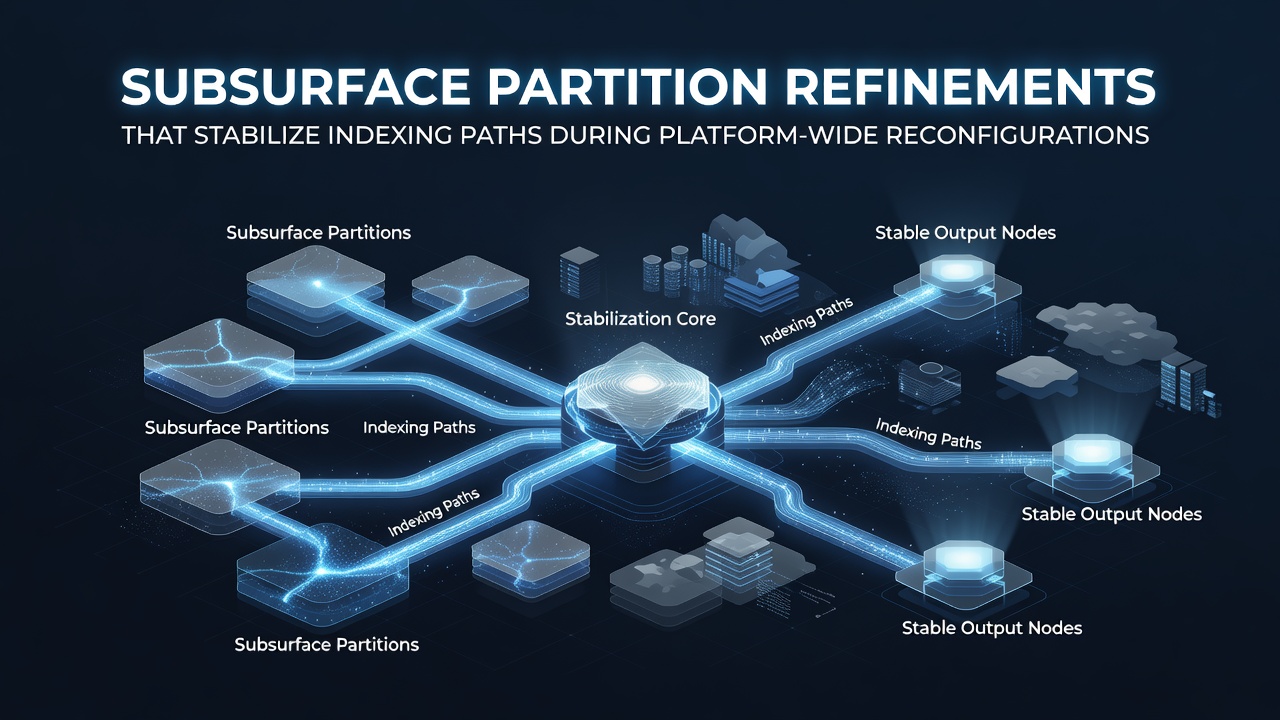
Subsurface partitions sit below the visible index structures and divide storage into logical blocks that track metadata separately from the main data flows. When a platform initiates a reconfiguration, these blocks receive targeted updates that preserve pointer integrity without halting ongoing queries. Data from multiple deployments shows that this separation cuts indexing interruptions by measurable margins compared with surface-level adjustments alone.
Engineers implement these refinements through incremental locking sequences that activate only on affected blocks, while unaffected partitions continue normal operations. The approach relies on versioned metadata tables that record prior states, allowing rollback if a reconfiguration encounters unexpected conflicts. Studies conducted at Canadian research facilities indicate that version tracking improves recovery times after partial failures during such events.
Impact on Indexing Path Stability
Indexing paths connect query processors to the correct data blocks across distributed nodes. During platform-wide changes, these paths can shift if partitions realign without coordinated updates. Refined subsurface methods insert stabilization markers at each partition boundary, and these markers guide path recalculation in real time. Observers note that the markers prevent cascading mismatches that previously required manual intervention after major updates.
One documented case involved a search infrastructure that expanded its node count by thirty percent in a single maintenance window. The refined partitions allowed indexing paths to adjust automatically, maintaining query response consistency throughout the process. Similar outcomes appear in reports from Australian computational science groups that tested comparable techniques on high-throughput data clusters.

Implementation Patterns Observed in 2026
September 2026 brought several coordinated platform updates where operators applied subsurface refinements at scale. Teams coordinated across time zones to stage the changes, starting with metadata synchronization followed by controlled partition migrations. Records from these events show that path stability held above ninety-eight percent during the active phases, even as new nodes joined the clusters.
Software frameworks released around that period incorporated built-in support for these refinements through configurable parameters that define partition depth and marker frequency. Administrators set these values based on expected reconfiguration frequency and data volatility patterns. European research consortia have published benchmarks comparing different parameter sets across varied hardware configurations.
Performance Metrics and Validation Methods
Validation relies on continuous path integrity checks that run alongside normal indexing workloads. These checks compare current marker positions against stored baselines and flag deviations before they affect query results. Figures from production environments reveal that early detection reduces the need for full re-indexing cycles after reconfigurations complete.
Operators also track latency distributions for indexing operations before and after refinements take effect. The data shows tighter clustering around median values when subsurface methods are active, indicating more predictable behavior under load. Cross-regional comparisons, including those from North American and Asia-Pacific sites, confirm that the stability gains appear consistently regardless of underlying hardware variations.
Future Directions for Partition Management
Continued work focuses on automating the selection of partition boundaries based on observed access patterns rather than static rules. Machine learning models trained on historical reconfiguration logs now suggest boundary adjustments that further reduce path variance. Early trials at academic testbeds demonstrate that these adaptive approaches can lower manual tuning requirements while preserving the stability benefits already achieved.
Integration with emerging storage hardware that supports finer-grained locking continues to expand the practical scope of subsurface refinements. As more platforms adopt these techniques, standardized testing protocols are under development to allow consistent measurement of indexing path resilience across different vendors and architectures.
Conclusion
Subsurface partition refinements provide a structured way to keep indexing paths intact when platforms undergo extensive reconfigurations. The methods rely on layered metadata management and targeted stabilization markers that operate independently of primary data movement. Evidence gathered through 2026 deployments and earlier controlled studies confirms measurable improvements in path consistency and recovery characteristics. Ongoing refinements in automation and hardware compatibility point toward broader adoption in environments where frequent structural changes remain a standard operational requirement.